What Does It Actually Look Like to Work With Me?
When people learn about my background, they’re often a little surprised. How does someone go from parole officer to yoga teacher to Ayurvedic practitioner? How do criminal justice, organizational training, ayurveda, coaching, Reiki, and yoga all fit together? To some people, these worlds may seem unexpected together. To me, they’ve always felt deeply connected. And the longer I do this work, the more connected it all feels. At the core of nearly every role I’ve held has been the same set of questions:
What helps people feel more supported? What helps people create meaningful change? What gets in the way? How do we balance structure and accountability with humanity, care, and connection?
Whether I was working in corrections, teaching college students, coaching staff, studying yoga philosophy, or learning Ayurvedic medicine, I kept returning to the same thing: understanding human behavior, healing, growth, and the environments that shape us. My work holds the trainer, the parole officer, the coach, the yoga teacher, the Ayurvedic practitioner, the lifelong student, and the human being who has continued to evolve through all of it. And because people often ask, I wanted to share a little more clearly about what it actually looks like to work with me.
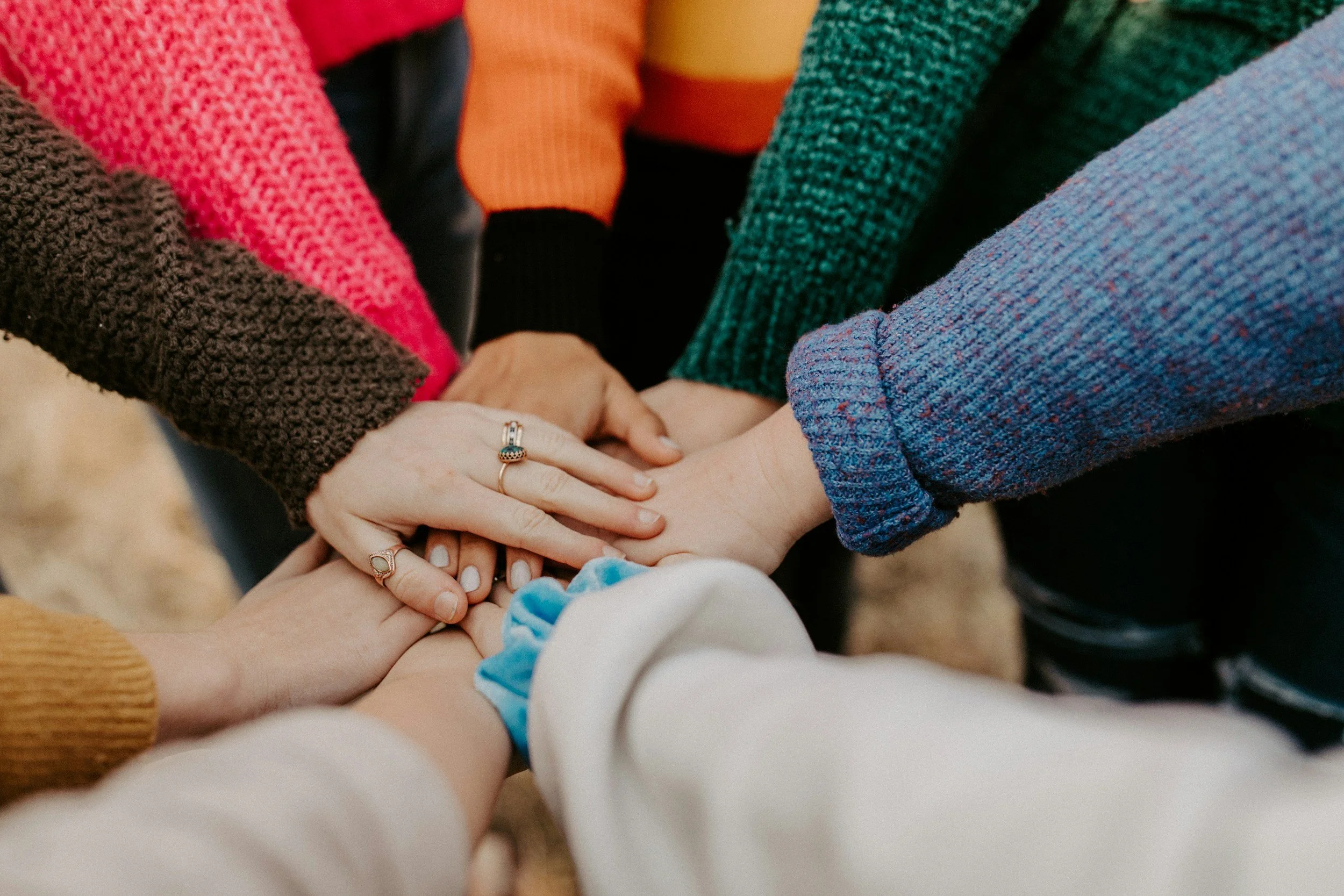
An image of various hands touching in a symbol of collaboration.
Ayurvedic Sessions
Ayurvedic sessions often begin with conversation and assessment.
Together, we explore your natural constitution (prakriti), your current state of imbalance (vikriti), your digestion (agni), stress patterns, routines, energy levels, sleep, and the ways your current lifestyle may or may not be supporting you. From there, I offer individualized recommendations that may include food, herbs, lifestyle practices, yoga, breathwork, bodywork, or supportive shifts to daily routines and rhythms. One of the things I appreciate most about Ayurveda is that it invites us to work with the body gradually and intentionally.
Rather than overwhelming someone with dramatic changes all at once, I prefer to approach this work steadily and collaboratively over time. Recommendations evolve. Practices shift. We pay attention together to what genuinely feels supportive, practical, and sustainable. Sometimes a recommendation deeply resonates. Sometimes it doesn’t. That’s part of the process too.
Intentional Coaching
My approach to coaching is deeply informed by years of working in corrections, organizational learning and development, evidence-based practices, yoga philosophy, and behavioral change work. While working for the Department of Corrections, I completed extensive training through the University of Cincinnati Corrections Institute in EPICS (Effective Practices in Community Supervision), a modality designed to bridge the academic side of criminal justice with the day-to-day realities of working with people in supervision. This work introduced me more deeply to cognitive behavioral approaches and the connection between thoughts, feelings, actions, and outcomes.
But beyond the technical skills, I became fascinated by the relational side of change. I loved watching officers build rapport with clients, translate needs into actionable steps, and support people in real time. I also loved coaching staff and helping them strengthen those skills. Today, intentional coaching sessions are a culmination of all of those experiences. Depending on the person, we may explore stress and burnout, communication, leadership, accountability, life transitions, patterns, boundaries, habits, behaviors, or creating more alignment in day-to-day life. These sessions are collaborative, reflective, and action-oriented. I often describe coaching this way: I help hold the container while you steer the ship.
1:1 Yoga Sessions
Private yoga sessions are individualized and adaptable to the person in front of me. Some people come in wanting support with mobility, strength, flexibility, breath awareness, or recovery from stress and burnout. Others are completely new to yoga and want a more supportive introduction before stepping into a group class. And some people are experienced practitioners or yoga teachers themselves who are looking to deepen their own practice, refine sequencing, or explore yoga philosophy more intentionally. My relationship with yoga has evolved tremendously over the years. I still remember standing up to cue the breath for the first time during my 200-hour yoga teacher training and realizing something inside of me had shifted. As my body became more flexible, so did my mind. Yoga became more than movement for me. It became a pathway toward greater awareness, curiosity, freedom, and expansion.
Reiki Sessions
I came to Reiki somewhat skeptically. I wasn’t entirely sure what I believed about energy work at first or whether I would truly feel a difference. But during my first Reiki attunement, something softened. What I experienced felt less about having answers and more about connection — to myself, to others, and to something deeper that I didn’t need to fully explain. Reiki sessions offer people a space to rest, regulate, slow down, and receive energetic support. People often describe feeling more grounded, emotionally clear, deeply relaxed, or simply grateful for an opportunity to pause. And sometimes, in a world that constantly asks people to push harder and move faster, that pause matters more than we realize.

An image of hands, seemingly glowing like the energy of reiki has been captured accordingly.
The Throughline
Before I ever worked in corrections, I studied social work. Looking back, I’m incredibly grateful for that foundation. Social work taught me to understand human behavior in the context of systems and environment. It taught me to look beyond individual choices and consider the larger structures, stressors, relationships, histories, and conditions shaping people’s lives. Later, I completed my master’s degree in criminal justice with an emphasis in organizational learning and development because I wanted to better understand systems, culture, leadership, and the ways organizations shape human behavior as well. At the same time, I continued pursuing yoga, Ayurveda, energy work, and more holistic and embodied approaches to healing.
Though these worlds may appear disconnected to some people, they’ve always felt connected to me. Throughout my work and studies, I’ve consistently been interested in the “how” of things: how people change, how systems influence behavior, how awareness shifts experience, and how we create more supportive ways of living. To me, they’ve always been part of the same larger exploration: How do we support people more humanely? How do we create environments that allow people to heal, grow, regulate, connect, and change? How do we bring more awareness, compassion, and intentionality into systems that often feel rigid, stressful, or disconnected?
That curiosity still drives me. And honestly, I think it always will.
Though my role may shift slightly depending on the session — educator, assessor, coach, yoga teacher, guide, collaborator, or supportive witness — my approach remains rooted in the understanding that each person is both deeply unique and deeply connected to something larger than themselves. While this work often begins at the individual level, its impact rarely stays there. The ways we care for ourselves inevitably shape the ways we show up for others.
As I continue to grow and evolve, so too will my offerings. And as you continue to grow and evolve, so too may your needs, practices, and recommendations. And I’d be honored to support you wherever you are in the process.
With gratitude,
Katie